software security in the age of ai
-
 James McFarland
 - 10 Apr, 2026
-
Haven’t you heard enough about AI already?!
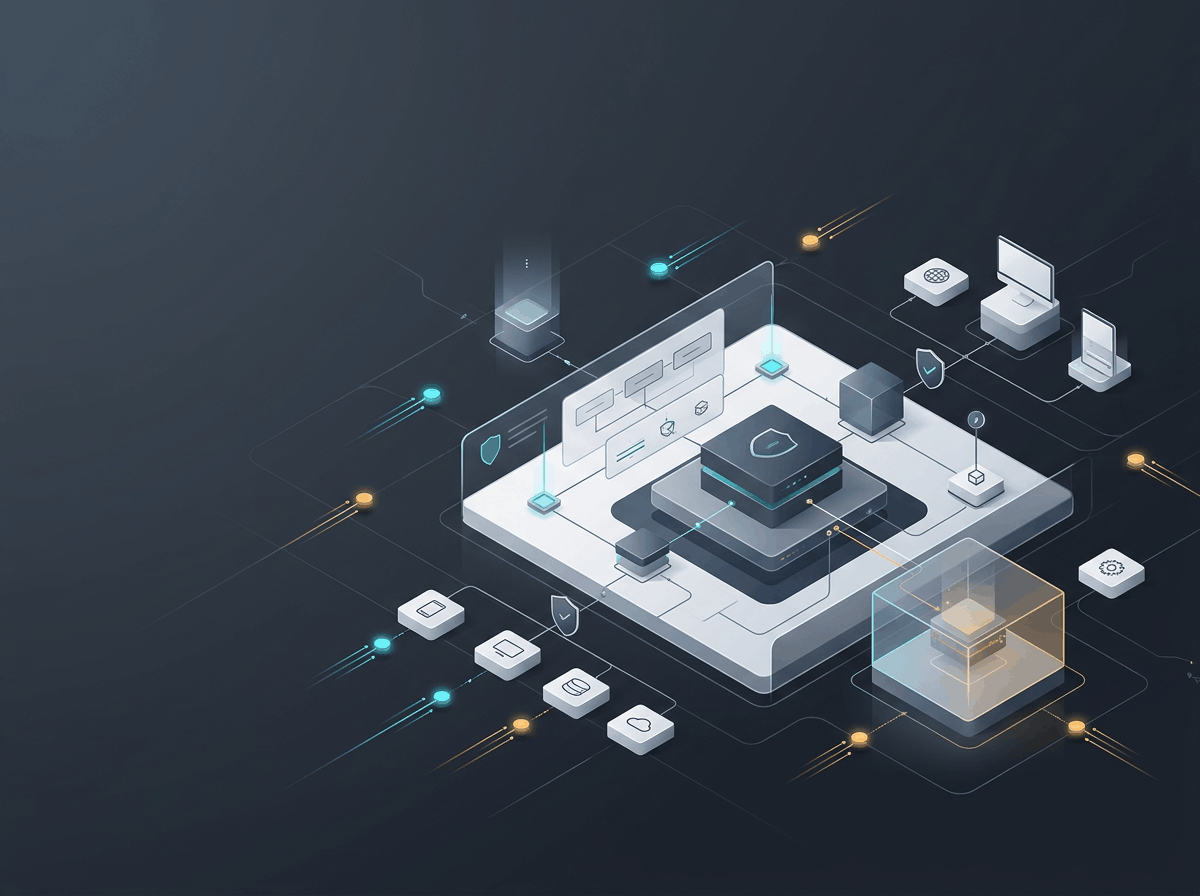
For transparency, here's the cover image prompt
: Create a clean, sharp, modern SaaS-style blog cover image for an article about software security in the age of AI. The theme is AI-assisted cyber defence versus AI-assisted attack. Show an abstract, high-end engineering aesthetic: dark or neutral background, precise geometric forms, subtle glowing network lines, layered system diagrams, defensive boundaries, and autonomous agents probing a secure digital environment. Suggest ideas like continuous adversarial testing, attack paths, threat modelling, and resilient infrastructure, but keep it abstract and tasteful rather than literal or cheesy.
Style: premium developer tooling brand, similar to Cloudflare’s blog, Linear, Vercel, Stripe, or a high-quality security startup. Minimal, polished, technical, elegant, editorial. Avoid stock art, shields, padlocks, hooded hackers, binary rain, or generic cyberpunk clichés.
Composition: strong focal point, lots of negative space for title overlay, landscape blog-header format, balanced and structured like a product engineering illustration. Use crisp lines, subtle gradients, soft glows, depth, and restrained detail.
Visual motifs: abstract secure system architecture, AI agents as moving nodes or light traces, segmented trust boundaries, monitored infrastructure, attack simulation in a sandboxed environment, connected devices or services represented as minimal icons or blocks. Convey that software is under constant automated pressure, but defended by equally advanced systems.
Color palette: charcoal, slate, soft whites, cool greys, deep blues, with restrained accents of electric cyan or amber. High contrast, premium, clean.
Mood: calm, intelligent, rigorous, high-quality engineering, proactive security, modern infrastructure, technically optimistic but serious.
No text, no logos, no UI screenshots, no people, no photorealism
This post was written in response to the Claude Mythos news; however, its implications reach far beyond Anthropic and apply to much of the wider software and security industry.
Claude Mythos
The Mythos model represents a jump in capability that we have not seen in a while, and I’d recommend reading the system card rather than having me rehash its claims here. In essence, it is a highly capable model which, like state-of-the-art (SoTA) models before it, lowers the barrier to entry for technical tasks. This time, that barrier appears to be the one surrounding security, penetration testing, and vulnerability research.
We are getting to the point where, cost and access aside, increasingly autonomous systems can run meaningful attack workflows against a particular target, exploring different avenues in parallel and doing so meticulously and persistently.
There are a few different areas within this news that are worth breaking down.
The benchmarks
An important caveat is that, whilst Anthropic have released very promising benchmarks, this model is only available to private groups at the time of writing. That means we cannot independently verify those benchmarks, or the model’s real-world performance more broadly.
Even so, this appears to be a large but natural step forward in capability, and one that the industry is going to have to come to grips with.
The private model
The model being held back is, to me, both understandable and concerning. Anthropic appear to feel they need to restrict access in line with their constitution and their stated goal of doing AGI safely, and in principle that makes sense.
The issue is that AI capabilities tend to proliferate quickly. OpenAI, Google, and others are usually not far behind one another, and it would be surprising if similar capabilities were not already being explored elsewhere. Keeping a model behind closed doors and limiting it to private groups may reduce short-term risk, but it does little to address the longer-term concerns now on the table.
As engineers, we need to understand the shape of these capabilities so that we can adapt and build systems that not only withstand this shift in the threat landscape, but also make constructive use of the same capabilities on the defensive side. Public models with Mythos-like capability are likely coming, and we need to be ready.
Why does this even matter?
A lot of software and connected devices are already far less secure than people assume. Many real-world attacks do not require elite expertise; they rely on common weaknesses, persistence, and a willingness to try known techniques repeatedly until something works.
I would be willing to bet that the majority of “smart home” devices could be compromised with relatively little effort. In many cases, it is not that the attacks are impossible or especially novel; it is that few people have had the incentive to spend the time doing it at scale. The knowledge around common security flaws (buffer overflows, excessive permissions, default credentials, poor authentication flows) is already widely available, and these are exactly the kinds of patterns that models can absorb and apply.
Take a category many will have in their homes: robot hoovers, cameras, smart bulbs, plugs, and other connected devices. AI-assisted attack workflows lower the cost of trying the same low-skill or moderately skilled attacks across a huge number of targets. Then expand that idea to every connected device. In many cases, variation between manufacturers, firmware, and hardware may have acted as a kind of accidental protection against large-scale automated exploitation.
What this means for security
When I was younger, I was exactly the sort of script kiddie running basic simulated attacks against systems. Even as an inexperienced novice, it was possible to find vulnerabilities or misconfigurations in poorly defended software systems.
What we have now is not just that same level of curiosity or trial and error. We now have models that can play a similar role, except they are not novices: they have access to vast amounts of information, can work persistently, and can iterate far faster than a person manually trying things one at a time.
This is not to say that we should stop developing or using these models. They are an incredibly important capability, and what they can do from both an educational and practical standpoint is remarkable. But we do need to be realistic about what they mean for the security baseline of the systems we build.
Distribution
This also exacerbates and exposes a wider issue that is already very well documented in software and device security: distribution and updates remain a major weak point.
Users do not update their software as often as they should, and often do not know that they need to. Some products do not even have proper update mechanisms. Others are not Internet-connected, or are only updated through manual intervention. Those systems are the really concerning part.
How do we solve that as an industry? I do not know, and I do not think there is a single answer.
One option is greater pressure on device manufacturers to invest the engineering effort needed to secure and maintain their products across their full supported lifetime. That is expensive and politically difficult, but not impossible. It becomes especially difficult when companies shut down, are acquired, change direction, or otherwise stop supporting products that remain deployed in the world.
Another possibility is some kind of community-driven effort to maintain or update unsupported devices. In theory, that could help; in practice, making that work safely, legally, and at scale would be extremely difficult. It would also rely on cooperation from manufacturers around source code, documentation, signing keys, update mechanisms, and other practical constraints.
Either way, we still have to deal with the fact that many devices in our homes, offices, and cars are insecure. The fact that they have not yet been breached does not mean they are secure. It may simply mean that no one has put sustained effort into breaking them yet.
New products absolutely must be designed with this threat model in mind. We should assume that throughout a product’s lifetime it will face constant, automated, and increasingly capable attack attempts.
Going forward
I believe we need to fight fire with fire.
We need defensive and adversarial models that can run against our applications and systems in the same way that red teams, blue teams, and security researchers do today. If attackers are using these tools, and they increasingly will be, then defenders need to use them too.
Take a web system, for example. Create an environment identical to production, with as much realistic data as possible. Isolate it, and run a set of agentic models against it with the goal of finding flaws and holes. Let them operate autonomously within that environment and see how they perform. Perhaps this could be a part of an applications CI/CD pipeline
That does not mean responsibility sits only with a company’s security operations centre or a platform team. Security has to be treated as a shared engineering responsibility. Individual developers, platform teams, security engineers, and product organisations all need to push for and advocate for more secure systems.
AI is already a force multiplier for writing software. It now also needs to become a force multiplier for securing it.